Premier Manufacturer

Data centers have evolved rapidly over the past decade as cloud computing, big data, and 5G have pushed infrastructure needs to new heights. One persistent industry debate is whether fiber optic cables will completely replace copper Ethernet cables. This post reviews both cabling types’ technical and economic aspects, supported by authoritative data and industry standards.
The Rise of Fiber Optic Cables

Fiber optic cables have become the backbone of modern data centers due to their high speed, massive bandwidth, and low signal attenuation over long distances. With the continuous growth in global IP traffic, as evidenced by Cisco’s projections in the Cisco Annual Internet Report (2018–2023) White Paper, the demand for high-performance interconnectivity is steadily increasing. In new installations, fiber optics is reported to account for a significant majority of cabling, particularly in large-scale data centers where long-distance communication is essential.
Advantages of Copper Ethernet Cables
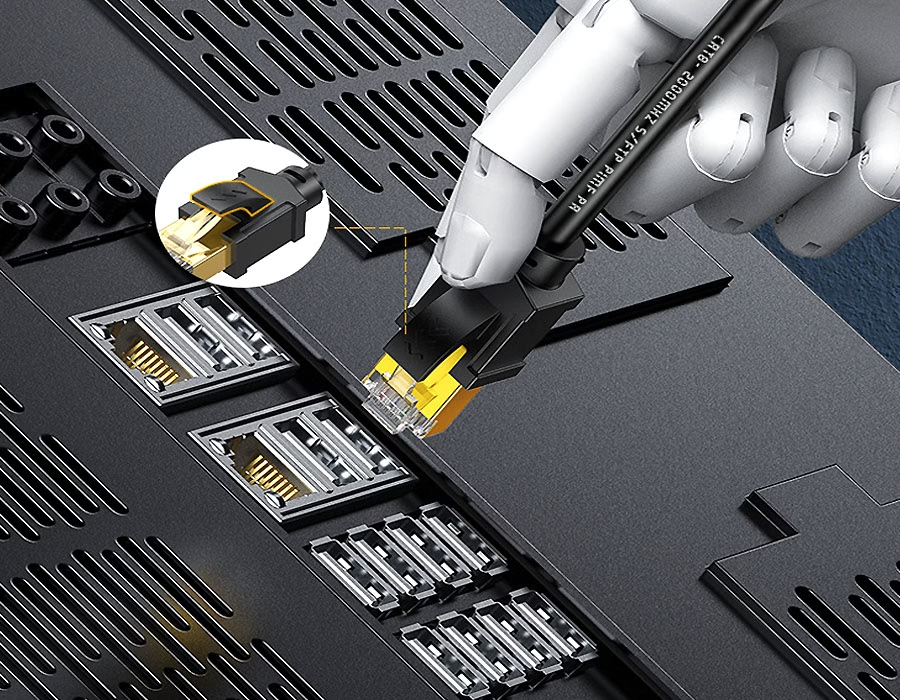
Despite the impressive capabilities of fiber optics, copper Ethernet cables remain indispensable for several reasons:
- Power and Data Transmission: Copper cables transfer data via electrical signals and deliver power through technologies like Power over Ethernet (PoE). This dual functionality makes them ideal for applications such as IP surveillance, VoIP, and wireless access points.
- Short-Distance Efficiency: In many indoor installations and office environments, where cable runs are relatively short, copper cabling is a cost-effective choice with an established record of reliability.
- Industry Standards Compliance: Copper networks are governed by widely accepted standards, including ANSI/TIA-568.2-D and ISO/IEC 11801, ensuring compatibility and performance across many applications.
Technical Metrics and Industry Trends
Market research continues to support a dual-path future for fiber and copper technologies in data centers. According to the Uptime Institute Global Data Center Survey Results 2022, the average Power Usage Effectiveness (PUE) in surveyed data centers is 1.55—a figure that reflects ongoing investments in energy efficiency but also highlights that incremental improvements are now more challenging. While the drive to minimize cable losses and maximize throughput favors fiber optics, the inherent benefits of copper in specific applications (such as PoE) help maintain its position in the market.
Fiber vs. Copper: A Complementary Ecosystem
Rather than a complete replacement scenario, the current technological trajectory suggests that fiber optic and copper cabling will continue to coexist:
- Fiber Optics for Backbone Connectivity: In high-capacity, long-distance links within and between data centers, fiber optics’ advantages—such as reduced mass, longer reach, and higher bandwidth—make them the preferred medium.
- Copper for Endpoint Interconnectivity: Copper cables retain importance for lower-speed, shorter-distance applications. Their ability to carry power and data makes them particularly useful for connecting devices like IP cameras, VoIP phones, and wireless access points within the data center environment.
Emerging trends indicate that copper cable technology is not stagnant; continual improvements (seen with the development of Cat8 and even anticipated Cat9 cables) will help copper remain relevant for years.
Looking Ahead
The future of data center networking is not about replacing one medium with another—it’s about leveraging both strengths. Fiber optics will drive the expansion of high-performance backbone networks, while copper Ethernet cables will continue to serve specialized needs with cost-effectiveness and integrated power delivery. Industry experts and authoritative reports by Cisco and Uptime Institute suggest that the technology mix will evolve but not converge into a single dominant solution.
Conclusion
Data centers operate in a complex environment that demands both speed and versatility. Fiber optic cables dominate when it comes to backbone connectivity for high-speed data transmission, as shown by Cisco’s in-depth analysis of global network trends. However, copper Ethernet cables remain crucial for specific applications like PoE and voice communications, whose unique properties are unmatched by fiber. Both cabling technologies’ co-existence and complementary integration ensure that modern data centers can meet diverse connectivity challenges.
.avif)
Alex Wang is the Marketing Manager at Romtronic, with a degree in International Business and over seven years of experience in the electronic cable and wire harness industry. He leads marketing efforts across North and South America, combining deep industry knowledge with strong sales experience.
In addition to overseeing global marketing strategy, Alex is also responsible for content development and editorial coordination, ensuring that Romtronic’s messaging remains clear, consistent, and engaging. His strength in market analysis and customer-focused approach helps clients make more informed purchasing and sales decisions.