Premier Manufacturer

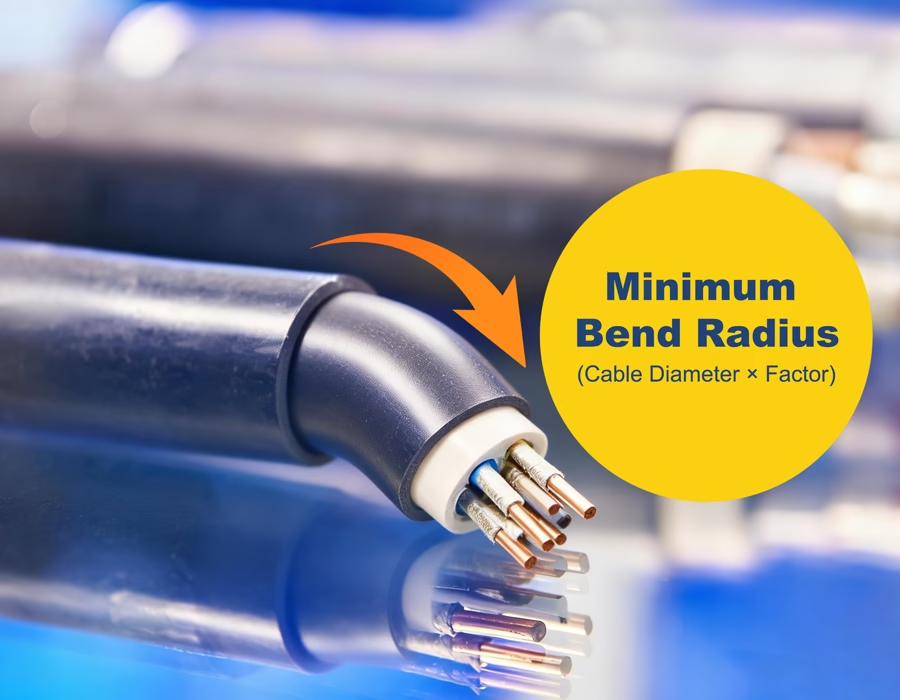
The bend radius for cables is often overlooked during project design, which can lead to signal performance issues, downtime, or reduced cable life expectancy. In tight installations, engineers/installers may be tempted to push the limits of the minimum cable bend radius and cite “it should be ok.”
Excessive bending beyond the minimum cable bend radius is the most common cause of hidden cable damage. The type of cable (e.g., fiber-optic, high-speed data, or electrical power) and its installation method will affect cable performance, reliability, and useful life.
What Is Cable Bend Radius?
The cable bend radius is the minimum radius at which a cable can be bent without causing mechanical or electrical damage. It is measured from the inside curve of the bend.
There are two important categories:
- Static bend radius – Applies to fixed installations where the cable does not move after installation.
- Dynamic bend radius – Applies to moving applications such as drag chains, robotics, or hinged equipment, where the cable flexes repeatedly.
Dynamic applications always require a larger bend radius due to long-term fatigue.
Why Cable Bend Radius Matters
Exceeding the minimum bend radius usually doesn’t cause immediate failure. Instead, it creates internal stress that builds up over time.
Common consequences include:
- Conductor fatigue and eventual breakage
- Signal attenuation or impedance changes in high-speed cables
- Shield deformation leading to EMI issues
- Insulation cracking, especially in colder environments
- Shortened cable lifespan—even if initial testing passes
This is why cables that “worked fine at installation” often fail months later in the field.
General Bend Radius Design Rules
While exact requirements vary by manufacturer, these industry-accepted rules of thumb are widely used during design and installation:
- Unshielded copper cables (UTP):
Minimum bend radius ≈ 4× the cable outer diameter (OD) - Shielded or braided cables:
Minimum bend radius ≈ 6–10× OD - Fiber optic cables:
- During installation (under tension): 20× OD
- After installation (no tension): 10× OD
- Coaxial cables:
Minimum bend radius ≈ 10× OD
Always consult the manufacturer’s datasheet for cable-specific requirements, especially for mission-critical or moving applications.
Bend Radius Requirements by Cable Type
Power Cables
Power cables are mechanically robust, but tight bends still accelerate conductor fatigue—particularly near terminations and fixed mounting points.
High-Speed Data Cables
USB, HDMI, Ethernet, and DisplayPort cables are sensitive to bending. Excessive bends can degrade signal integrity long before a visible failure occurs.
Shielded and Braided Cables
Once a shield is deformed by tight bending, EMI protection is compromised and difficult to recover.
Fiber Optic Cables
Fiber is the most bend-sensitive. Macro- and micro-bending can cause permanent signal loss, even if the jacket appears undamaged.
Cable Assemblies and Wire Harnesses
The area directly behind the connectors is the most common failure point due to concentrated bending stress.
Common Cable Bend Radius Mistakes
Many cable failures are not caused by poor materials but by poor handling.
- Ignoring the minimum bend radius during installation
“It fits” does not imply reliability. - Sharp bends behind connectors
This high-stress zone is responsible for many intermittent failures. - Using one rule for all cable types
Fiber, power, and high-speed signal cables behave very differently. - Over-tightening zip ties
Tight plastic ties create micro-bends and crush internal structures. Hook-and-loop straps are safer. - Underestimating dynamic movement
Repeated flexing requires a much larger bend radius than static routing. - Ignoring environmental conditions
Cold temperatures increase stiffness and raise the risk of insulation cracking.
Best Practices for Bend Radius-Friendly Design
- Plan cable routing early in the design phase
- Allow enough space for smooth, gradual bends
- Use cable trays, J-hooks, or guides sized correctly
- Leave service loops to prevent tension during maintenance
- Add proper strain relief near connectors
- Increase bend radius for moving or vibration-prone applications
Small design decisions here can prevent costly failures later.
Bend Radius in Custom Cable Assemblies
When designing custom cable assemblies, bend radius should be treated as a fundamental design criterion rather than an afterthought. Specifically, the bending stress distribution will be affected by design factors such as overmold design, exit angle, jacketing material, and strain relief geometry.
Validating the bending radius during design reviews and testing is necessary to ensure the assembly will function properly in the field, rather than just theoretically.
Conclusion
Bend radius is more than a guideline; it can also indicate reliability. Exceeding the bend radius can create damage that may not be visible, degrade the signal, or actually cause the cable to fail prematurely.
To maximize cable lifespan, performance, and system stability, you must adhere to bend radius guidelines.
Cable installations that require tight spaces, high-speed signals, or repeated movements require special consideration for bend radius from day one.
FAQs
What is the minimum bend radius for cables?
It typically ranges from 4× to 10× the cable’s outer diameter, depending on cable type and construction.
Does bend radius affect signal performance?
Yes. Tight bends can cause impedance changes, signal loss, and EMI, especially in high-speed and fiber-optic cables.
Is the bend radius different for moving cables?
Absolutely. Dynamic applications require a larger bend radius to handle repeated flexing without fatigue damage.
Ready to Reduce Cable Failures?
At Romtronic, we design and manufacture custom cable assemblies and wire harnesses with bend radius considerations built in—from material selection to overmolding and strain relief.
📩 Contact us today to discuss your application and get expert guidance on reliable cable design.
.avif)
Sam Wu is the Marketing Manager at Romtronic, holding a degree in Mechatronics. With 12 years of experience in sales within the electronic wiring harness industry, he manages marketing efforts across Europe. An expert in cable assembly, wiring harnesses, and advanced connectivity solutions, Sam simplifies complex technologies, offering clear, actionable advice to help you confidently navigate your electrical projects.