 Premier Manufacturer

A wire harness in mission-critical applications is only as robust as its weakest thermal connection, whether in the microgravity of outer space or the extremely high temperatures generated by an aircraft engine. Inappropriate material selection can lead not only to maintenance concerns but also to complete system failure.
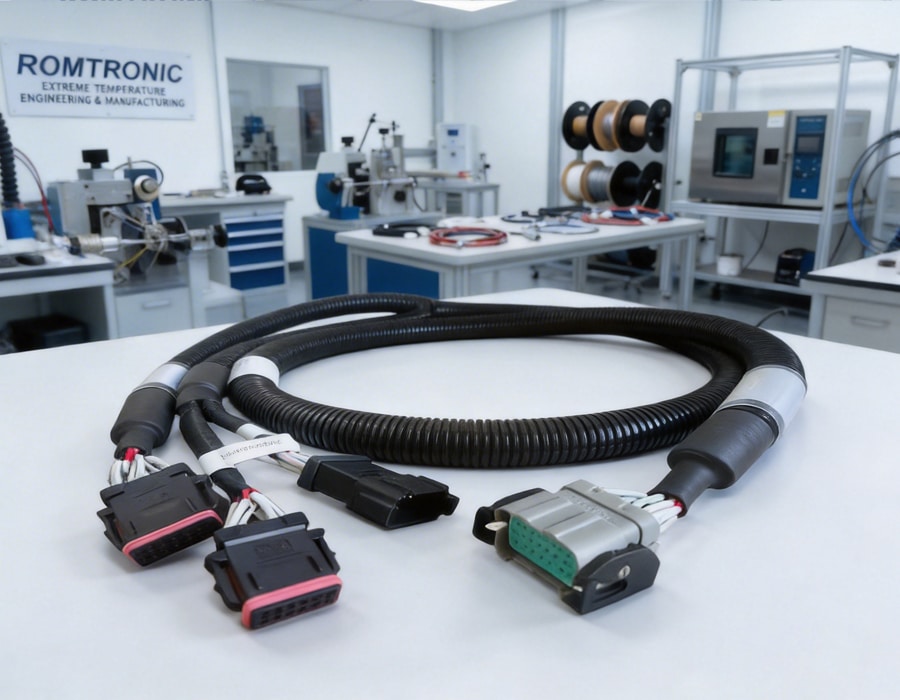
The traditional definition of “standard” is no longer relevant for an engineer designing for the 2026 industrial environment. This guide will explore high-performance materials and design methodologies to maintain both mechanical durability and signal integrity in dynamic temperature environments with extreme temperature fluctuations.
1. Defining the Thermal Spectrum
Before selecting materials, you must first define your “limit” criteria. At Romtronic, we categorise thermal management challenges into three main areas to ensure that each component is over-engineered for its specific lifecycle:
| Temperature Range | Common Applications | Key Material Challenge |
| High-Heat (up to 200°C) | Automotive Engines, Industrial Sensors | Oxidation & Long-term hardening |
| Ultra-High Heat (200°C – 1000°C+) | Aerospace, Smelting, Glass Mfg | Melting, Outgassing, Flame resistance |
| Cryogenic & Thermal Shock | Space Exploration, LNG, Medical | Embrittlement & Rapid contraction |
2. The Shield: Insulation and Jacketing
The outer layer of a cable assembly serves as the first line of defence. When standard PVC and polyethene fall short, these high-performance polymers step in:
- PTFE & Fluoropolymers: The gold standard in medical devices and aerospace applications. They remain stable at temperatures up to 260°C and are virtually chemically inert.
- Silicone Rubber: Suitable for applications requiring a small bend radius. Remains flexible within a temperature range of -50°C to +200°C.
- Fibreglass & Ceramic Braids: When temperatures exceed 450°C, organic plastics carbonise. In environments with direct flame exposure, inorganic fibres provide a critical thermal barrier.
3. The Heart: Conductor Plating & Shielding
In high-temperature environments, ordinary copper oxidises rapidly, leading to increased resistance and the generation of more heat.
- Nickel-Plated Copper: An industry-standard material suitable for temperatures ranging from 250°C to 450°C. The nickel layer effectively blocks oxygen diffusion.
- Pure Nickel: Used for ultra-high-temperature applications (up to 600°C and above).
Engineering Note: In harsh environments, high-temperature shielding (using silver or nickel-plated copper braided mesh) is essential to combat electromagnetic interference (EMI) and maintain signal integrity.
4. Connectors and Terminals: The Often Overlooked Link
Even when using high-temperature wires, terminal connections often fail. To ensure the reliability of the entire system, we use materials that maintain dimensional stability even under extreme stress:
- High-Temperature Housings: We use advanced plastics such as PEEK, PPS, or LCP (liquid crystal polymer) to prevent deformation and maintain pin alignment.
- Nickel-Plated Terminals: These prevent oxidation between terminals and wires, thereby avoiding conditions that could cause dangerous voltage drops.
- High-Temp Crimp Contacts: Designed to maintain mechanical tension even as the metal expands significantly.
5. Engineering Design Tips for Extreme Environments
Material selection alone is not enough. A well-designed industrial wire harness must take temperature, vibration, and mechanical stress into account simultaneously:
- Thermal Shielding: Add secondary reflective sleeves near localised heat sources to prevent the formation of “hot spots.”
- Expansion Management: Design “service loops” and flexible routing to accommodate the physical expansion and contraction of metals during rapid thermal shock cycles.
- Separation of Concerns: Keep high-temperature power lines away from sensitive signal lines to prevent thermal interference.
- Strain Relief: Implement appropriate stress relief measures and use dedicated rear housings to ensure that mechanical stress does not damage insulation softened by heat.
6. Real-World Applications
Wiring harnesses designed to withstand extreme temperatures are the backbone of today’s most demanding industries:
- Aerospace: Avionics wiring, engine sensors, and vacuum-sealed satellite communication links.
- Electric Vehicles (EV): High-voltage battery management systems (BMS) and power distribution systems.
- Oil & Gas: Downhole tools and drilling sensors used in environments where high pressure and high temperatures coexist.
- Industrial Robotics: High-cycle motors and control harnesses in foundries or cleanrooms.
Conclusion: Reliability Starts With the Right Materials
Extreme environmental conditions leave very little room for error or margin of safety. Having the proper selection of conductor plating, insulation, shielding materials, and connector materials makes a great difference in the long-term reliability of wire harnesses.
Material selection is not just a specification; it is the basis of long-term system reliability from Romtronic’s point of view. The engineering processes at Romtronic take into account the most challenging variables in the design, from extreme heat to rapid thermal shock.
[Contact our Engineering Team today] for help in creating a custom design for your next extreme environment project!
.avif)
Alex Wang is the Marketing Manager at Romtronic, with a degree in International Business and over seven years of experience in the electronic cable and wire harness industry. He leads marketing efforts across North and South America, combining deep industry knowledge with strong sales experience.
In addition to overseeing global marketing strategy, Alex is also responsible for content development and editorial coordination, ensuring that Romtronic’s messaging remains clear, consistent, and engaging. His strength in market analysis and customer-focused approach helps clients make more informed purchasing and sales decisions.

