


In modern engineering, the challenge is clear: equipment continues to shrink in size, yet its internal “nervous system” grows increasingly complex. Whether designing autonomous mobile robots (AMRs), electric vehicle battery modules, or high-density medical devices, wiring solutions within confined spaces have become a critical factor determining system reliability.
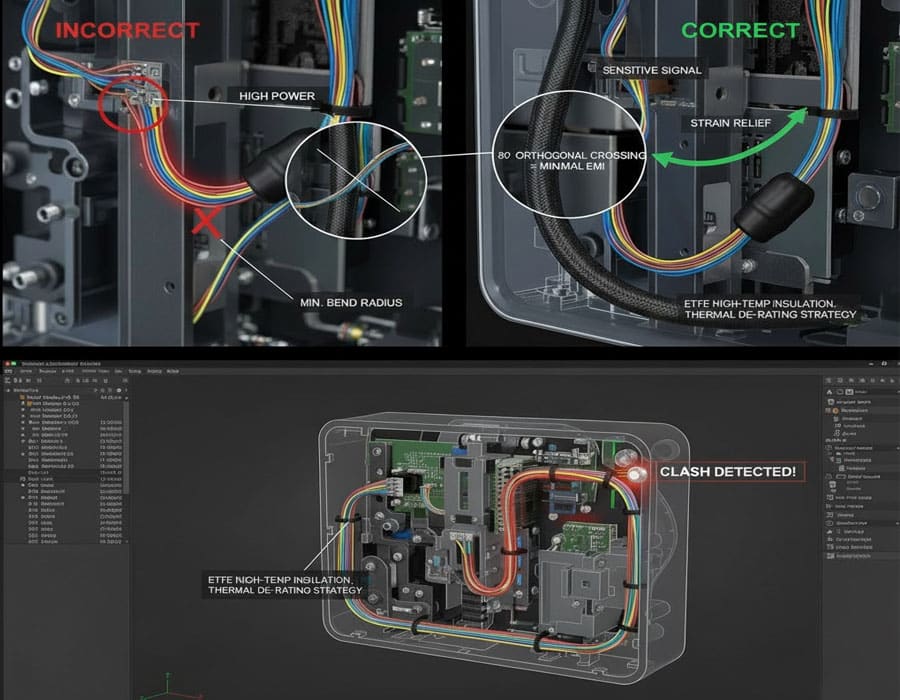
At Romtronic, we specialise in solving these spatial puzzles through advanced Custom Wire Harness Manufacturing and precision engineering.
1. Why Precision Routing Matters
In confined packaging spaces, “just barely adequate” routing creates “spatial debt”—technical issues that surface during mass production or practical application:
- Mechanical Stress: Sharp bends cause copper wire fatigue damage.
- EMI/EMC Noise: Signal crosstalk triggered by proximity to power lines.
- Thermal Accumulation: Thermal stagnation degrades insulation layers.
- Serviceability: Inaccessible connectors incur high repair costs.
2. Core Engineering Principles for Tight Spaces
A. Mastering the Bend Radius
The most common failure in confined spaces is the violation of minimum bend radius (MBR) requirements.
- Rule: Static cables must maintain a minimum bend radius of 6 to 10 times their outer diameter. For dynamic applications, this value must increase to 12 to 15 times.
- Pro Tip: Use custom cable assemblies with flexible sheath designs that allow compact bending without compromising signal quality.
B. Thermal Management & Material Choice
In confined areas, airflow is often nonexistent.
- Optimisation: Utilise high-temperature insulation materials such as ETFE or PTFE. These materials enable thinner wall thicknesses and smaller dimensions, thereby saving critical space.
- Romtronic Advantage: Our engineering support team will assist you in selecting materials that balance space savings with thermal safety.
C. EMI/EMC Integrity
High component density means sensors are placed adjacent to power modules.
- Strategy: Physically isolate power lines from signal lines. If crossing is necessary, ensure a 90-degree angle.
- Shielding Solution: Explore our Medical Wire Harness solutions featuring advanced shielding technology to ensure signal purity in the most compact diagnostic equipment.
3. Practical Solutions for the “War of Space”
- Modular Architecture: Break down complex wiring harnesses into manageable sub-units to simplify assembly processes and prevent spaghetti-like tangles.
- Secure Fixation: Employ low-profile brackets to prevent cables from rubbing against sharp metal edges—a critical step in industrial wiring harness design.
- 3D Prototyping: We use Digital Twins to perform Clash Detection, identifying interference issues before a single wire is cut.
4. Common Pitfalls to Avoid
- Over-tightening cable ties: Never “choke” high-speed data cables, as this will compromise impedance characteristics.
- Ignoring the “Water Path”: In sealed enclosures, always use drip rings to prevent moisture ingress into connectors.
- Lack of Documentation: Ensure every custom cable routing path is documented in Quality Control standards to guarantee batch-to-batch consistency.
5. Conclusion: Excellence in Every Millimetre
Mastering wire harness routing in confined spaces is an art supported by rigorous physical principles. Through planning and collaboration with professional manufacturing partners, you can transform potential failure points into reliable systems.
Ready to optimise your next project?
Explore our comprehensive capabilities and discover how we tackle complex industrial challenges.
Contact a Romtronic engineer today for a design review.
.avif)
Sam Wu is the Marketing Manager at Romtronic, holding a degree in Mechatronics. With 12 years of experience in sales within the electronic wiring harness industry, he manages marketing efforts across Europe. An expert in cable assembly, wiring harnesses, and advanced connectivity solutions, Sam simplifies complex technologies, offering clear, actionable advice to help you confidently navigate your electrical projects.

