


A wire harness is only as tough as its weakest thermal link. That’s true whether it’s sitting in the microgravity of a satellite or bolted next to an aircraft engine running at full throttle. Pick the wrong material, and you’re not just looking at extra maintenance. You’re looking at a system failure, and often at the worst possible moment.
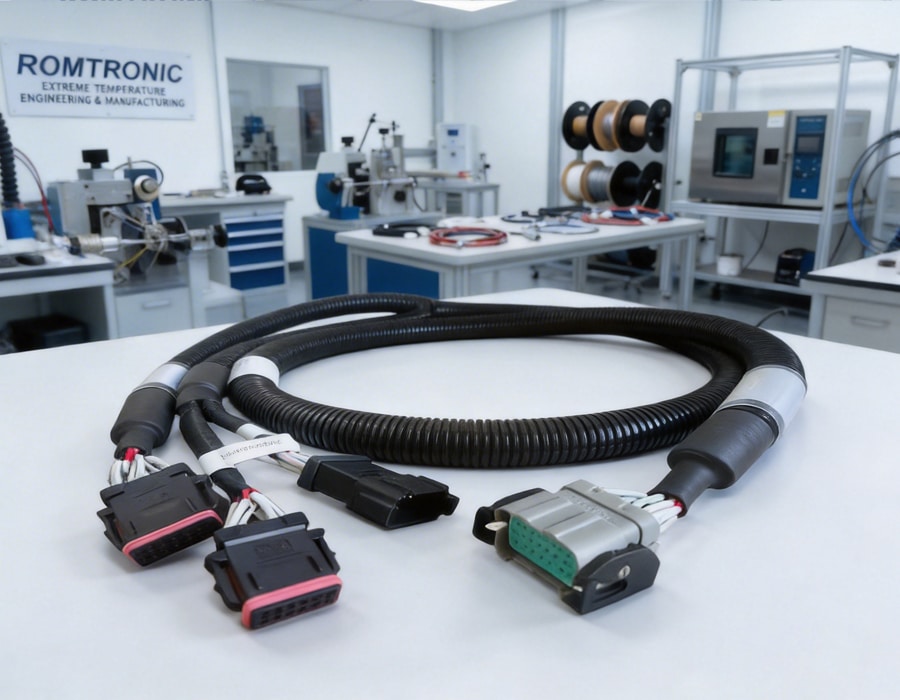
“Standard” doesn’t really mean much anymore for engineers designing harnesses in 2026. This guide walks through the materials and design choices that actually hold up in extreme heat, extreme cold, and the wild temperature swings in between.
1. Know Your Thermal Range First
Before you pick a single material, you need to nail down your actual temperature limits. At Romtronic, we sort thermal challenges into three buckets. That way, every component gets engineered for the specific conditions it’ll live in, not just a generic worst case.
| Temperature Range | Common Applications | Key Material Challenge |
|---|---|---|
| High-Heat (up to 200°C) | Automotive engines, industrial sensors | Oxidation and long-term hardening |
| Ultra-High Heat (200°C–1000°C+) | Aerospace, smelting, glass manufacturing | Melting, outgassing, flame resistance |
| Cryogenic & Thermal Shock | Space exploration, LNG, medical | Embrittlement, rapid contraction |
That cryogenic category deserves its own callout, honestly — designing cable for near-absolute-zero conditions brings a completely different set of failure modes than heat does, even though people lump “extreme temperature” together as one problem.
Quick Reference: Material Temperature Ratings
If you just need the numbers without the backstory, here’s the cheat sheet:
| Material | Min Temp | Max Temp | Typical Role |
|---|---|---|---|
| Standard PVC | -20°C | 105°C | General-purpose insulation |
| XLPE | -40°C | 125°C | Automotive and appliance wire |
| Silicone Rubber | -50°C | 200°C | Flexible, tight-bend applications |
| ETFE | -65°C | 150°C | Aerospace and military wire |
| PTFE / FEP | -65°C | 260°C | Medical, aerospace, chemical-resistant |
| Polyimide (Kapton) Tape | -269°C | 400°C | Cryogenic wraps, motor windings |
| Nickel-Plated Copper | -196°C | 450°C | High-heat conductor plating |
| PEEK (connector housings) | -65°C | 260°C | High-temp connector bodies |
| Fiberglass / Ceramic Braid | -196°C | 1000°C+ | Flame-direct exposure sleeving |
| Pure Nickel Conductor | -196°C | 600°C+ | Ultra-high-heat conductor |
Treat this as a starting point, not a final spec — actual ratings shift depending on continuous vs. intermittent exposure, and whether the material’s also dealing with vibration or chemical contact at the same time.
2. Insulation and Jacketing: Your First Line of Defense
The outer layer of a cable takes the first hit from heat, cold, or chemical exposure. Standard PVC and polyethylene just aren’t built for it. Here’s what actually holds up, broken down by the properties that matter most in material selection for cable jackets.
PTFE and Fluoropolymers
This is the gold standard in medical devices and aerospace work. PTFE stays stable up to 260°C and barely reacts with anything chemically. If you need one material that just doesn’t cause problems, this is usually it.
Silicone Rubber
Silicone is your pick when you also need a tight bend radius. It stays flexible from -50°C all the way up to +200°C, which covers a surprising amount of real-world use cases.
Fiberglass and Ceramic Braids
Past 450°C, organic plastics start to carbonize — they basically turn to char. That’s where inorganic fibers come in. In any environment with direct flame exposure, fiberglass or ceramic braid is doing the real work of keeping the conductor alive. For a broader look at where each material tops out, our guide on high-temperature cable options covers the full range.
3. Conductor Plating and Shielding: The Part People Forget
Ordinary copper oxidizes fast once things heat up. That oxidation drives resistance higher, which generates even more heat — a bad feedback loop you want to avoid entirely.
Nickel-Plated Copper
This is the industry standard for 250°C to 450°C applications. The nickel layer blocks oxygen diffusion, which is exactly what keeps the copper underneath from degrading. If you want the full picture on how different platings hold up over repeated thermal and mechanical cycling, we’ve written up the science behind connector plating and corrosion resistance.
Pure Nickel
For anything pushing past 600°C, pure nickel takes over. It costs more, but at that temperature range, you don’t have many other options that actually work.
Shielding at High Temperatures
In harsh environments, EMI doesn’t just go away because it’s hot. High-temperature shielding — usually silver or nickel-plated copper braided mesh — is what keeps signal integrity intact. If you’re also fighting weight constraints alongside heat, graphene-based shielding is worth a look too.
4. Connectors and Terminals: The Weak Link Nobody Talks About
Here’s something that trips people up constantly: you can spec a perfect high-temperature wire and still get a system failure, because the connector fails first.
To keep the whole system reliable, we build in materials that hold their shape under real thermal stress:
- High-temperature housings. Advanced plastics like PEEK, PPS, and LCP (liquid crystal polymer) resist deformation and keep pins aligned even as everything around them expands.
- Nickel-plated terminals. These stop oxidation from building up between terminals and wires — oxidation that would otherwise cause dangerous voltage drops.
- High-temp crimp contacts. These are built to hold mechanical tension even as the surrounding metal expands significantly.
5. Design Tips That Matter as Much as Material Choice
Picking the right material only gets you halfway there. A well-designed industrial wire harness has to account for temperature, vibration, and mechanical stress all at once, not one at a time.
A few things worth building into your design from day one:
- Thermal shielding. Add reflective sleeves near localized heat sources to stop hot spots from forming in the first place.
- Expansion management. Build in service loops and flexible routing so metal can expand and contract through thermal shock cycles without stressing a connection point.
- Separation of concerns. Keep high-temperature power lines physically apart from sensitive signal lines. Thermal interference is a real failure mode, not just a theoretical one.
- Strain relief. Use proper strain relief and dedicated rear housings so mechanical stress doesn’t tear into insulation that’s already softened from heat. And don’t ignore vibration as a failure mode — heat and vibration together fail a harness a lot faster than either one alone.
6. Where This Actually Shows Up in the Real World
Extreme-temperature harnesses aren’t a niche concern. They’re quietly holding together some of the most demanding equipment running today.
- Aerospace. Avionics wiring, engine sensors, and vacuum-sealed satellite communication links all depend on it.
- Electric vehicles. High-voltage battery management systems and power distribution systems live in a genuinely hot, vibration-heavy environment.
- Oil and gas. Downhole tools and drilling sensors deal with high pressure and high heat at the same time, often thousands of feet underground.
- Industrial robotics. High-cycle motors and control harnesses in foundries or cleanrooms need to survive constant thermal cycling without drifting out of spec.
Aerospace applications specifically also lean on connector standards built for these exact conditions, since a connector failure at altitude isn’t something you get to troubleshoot on the spot.
Bottom Line: Reliability Starts With the Right Materials
Extreme environments don’t leave much room for error. The right combination of conductor plating, insulation, shielding, and connector materials is what actually determines whether a harness lasts five years or fails in five months.
Material selection isn’t just a line item on a spec sheet. It’s the foundation of long-term reliability. Our engineering team works through the toughest design variables up front, from extreme heat all the way to rapid thermal shock, so you’re not discovering a weak point in the field.
If you want more on keeping cable assemblies alive under stress generally, our guide on improving cable assembly lifespan in harsh environments is a good companion read to this one.
Frequently Asked Questions
A: It depends entirely on the materials. Standard PVC tops out around 105°C. PTFE handles up to 260°C. Push past 450°C, and you’re into fiberglass or ceramic braid territory, with some specialized designs holding up past 1000°C for short exposures.
A: For most high-heat industrial and aerospace work, PTFE is the default choice. It’s stable, chemically inert, and handles up to 260°C reliably. Above that, you’re looking at fiberglass or ceramic braiding instead of a standard polymer jacket.
A: Copper oxidizes faster as temperatures climb, and that oxidation increases resistance. Higher resistance generates more heat, which speeds up the oxidation even further. Nickel plating blocks that oxygen diffusion and breaks the cycle before it starts.
A: Yes, and this is where a lot of designs quietly fail. A harness can use perfect high-temperature wire and still fail if the connector housing deforms or the terminals lose contact tension under heat. Match your connector rating to your wire rating, not just the ambient temperature.
A: Heat causes oxidation, outgassing, and melting. Cold causes embrittlement and rapid contraction, which is a completely different failure mode. A material that survives 500°C won’t necessarily survive -196°C, and vice versa — the two problems need separate engineering approaches.
A: Yes. Heat softens insulation and stresses connection points on its own, and vibration adds a second load on top of that. The combination fails a harness noticeably faster than either heat or vibration alone, so both need to be designed for together.
A: It depends on where in the system the wire sits. Nickel-plated copper handles most aerospace applications up to 450°C. Pure nickel comes into play for the hottest zones, typically past 600°C, where plated copper starts to lose reliability.
A: All three resist heat well, but they’re not interchangeable. PEEK handles the widest range and the toughest chemical exposure, which is why it costs more. PPS is a solid mid-range option for less extreme conditions. LCP holds tight dimensional tolerances especially well, which matters for dense, high-pin-count connectors.
A: Yes, and it’s actually one of the widest-range materials available — polyimide tape holds up from cryogenic temperatures down around -269°C up to roughly 400°C. It shows up constantly in motor windings and as a wrap layer in aerospace and cryogenic applications where flexibility at extreme cold matters as much as heat resistance.
A: Yes, though the numbers run tighter than what you’d use for standard insulation. Ceramic and fiberglass braids are more rigid than PTFE or silicone, so bending them too sharply can crack the fibers instead of just flexing. It’s worth checking manufacturer bend specs specifically for the braid, not just the underlying wire.
A: PTFE and its close relative FEP cover the widest practical range for most applications, running from about -65°C up to 260°C. If you need to go colder or hotter than that on either end, you’re typically moving into specialized materials like polyimide tape or ceramic braiding rather than a single do-it-all insulation.
Ready to Design for Your Actual Operating Conditions?
Generic “high-temp” specs don’t cut it once you’re past 200°C. Contact our engineering team with your real operating range, and we’ll help you build a harness that’s engineered for the conditions it’ll actually see — not just the ones on a generic datasheet.
.avif)
Alex Wang is the Marketing Manager at Romtronic, with a degree in International Business and over seven years of experience in the electronic cable and wire harness industry. He leads marketing efforts across North and South America, combining deep industry knowledge with strong sales experience.
In addition to overseeing global marketing strategy, Alex is also responsible for content development and editorial coordination, ensuring that Romtronic’s messaging remains clear, consistent, and engaging. His strength in market analysis and customer-focused approach helps clients make more informed purchasing and sales decisions.

