Premier Manufacturer

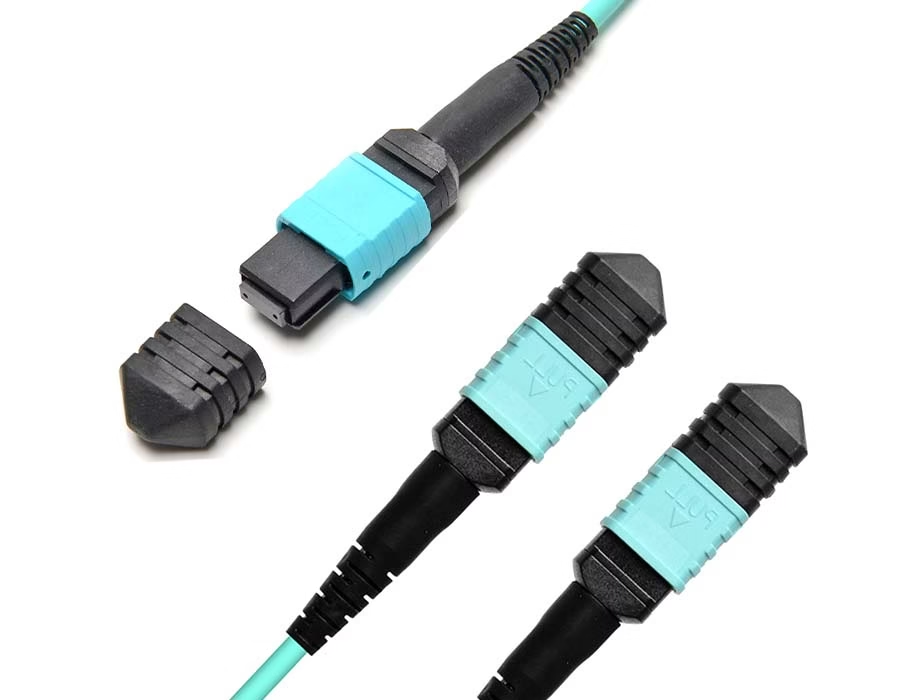
If you’re researching high-density fiber optics, then you’re likely to see the terms “MPO” and “MTP” pop up quite a bit. The two connectors share a similar appearance and connect in the same way; however, they are not identical, so understanding their differences is vital to designing fast, reliable networks.
Here’s the simple truth:
All MTP connectors are MPO connectors, but not all MPO connectors are MTP connectors.
Think of MTP as a “premium, engineered MPO” built for performance-critical environments.
In this article, we will try to provide a clear, practical breakdown of the differences between MTP and MPO.
What Is an MPO Connector?
MPO (Multi-Fiber Push-On) is a generic, standardized multi-fiber connector developed by NTT in Japan. MPO connectors comply with IEC-61754-7 and TIA-604-5 standards, and they’re manufactured by many companies worldwide.
Key characteristics of MPO:
- Standard multi-fiber connector (12/24/48+ fibers)
- May use fixed housings
- Often constructed with plastic pin clamps
- Guide pins use chamfered tips
- Adequate for general-purpose fiber networks
- Performance depends heavily on the manufacturer
MPO works well for typical enterprise deployments but may struggle with durability or low-loss requirements in high-density data centers.
What Is an MTP Connector?
MTP (Multi-Fiber Termination Push-On) is a registered trademark of US Conec—essentially a high-performance MPO with patented mechanical and optical improvements.
Why MTP is considered “premium”:
- Fully compliant with the MPO standard
- Engineered for lower insertion loss and higher return loss
- Built for durability, consistency, and high-speed systems (40G/100G/200G/400G)
- Designed to withstand more mating cycles with less end-face wear
If you’re running a hyperscale data center, cloud backbone, or AI computing cluster, MTP usually becomes the first choice.
Key Engineering Differences: MTP vs. MPO
Here are the mechanical and optical enhancements that set MTP apart:
1. Floating Ferrule (MTP only)
Allows the ferrule to move slightly under load, maintaining better physical contact.
Benefits:
- Higher durability
- Improved long-term stability
- Better optical performance under repeated mating
Standard MPO ferrules do not float, which can lead to increased wear or misalignment over time.
2. Removable Housing (MTP only)
The MTP shell can be removed in seconds.
Why it matters:
- Easy re-polishing
- On-site re-work
- Simple gender change (pin/no-pin)
- Quick polarity alterations
Most MPO housings are fixed, making field maintenance harder.
3. Metal Pin Clamp (MTP) vs. Plastic Clamp (MPO)
MTP uses metal pin clamps for better strength and pin retention.
MPO often uses plastic, which is more prone to deformation or damage.
4. Guide Pins: Oval (MTP) vs. Chamfered (MPO)
- MTP guide pins: Oval-shaped tip reduces wear and improves alignment
- MPO guide pins: Chamfered tip, more susceptible to end-face abrasion
Better guide pin design = better ferrule alignment = lower insertion loss.
5. Spring Design
MTP’s spring maintains optimal space around fibers, preventing pressure and micro-bending during mating.
Standard MPO springs may not be as optimized.
Performance Comparison
| Feature | MTP Connector | MPO Connector |
|---|---|---|
| Origin | US Conec (registered brand) | Multi-vendor, generic term |
| Engineering | Enhanced, patented mechanical & optical design | Standard MPO geometry |
| Ferrule System | Floating MT ferrule | Fixed MT ferrule |
| Pin Clamps | Metal | Plastic (common) |
| Guide Pins | Oval for reduced wear | Chamfered |
| Durability | Higher mating cycle lifespan | Lower durability |
| Loss Performance | Typically lower IL & higher RL | Varies by manufacturer |
| Maintenance | Easier field service & rework | More limited |
| Compatibility | Fully compatible with MPO | Compatible with MTP but may limit performance |
MTP often remains within spec after 600+ mating cycles.
Generic MPO may show noticeable wear after ~500 cycles.
Optical Performance & Reliability
Because of its tighter tolerances and enhanced ferrule alignment, an MTP connector delivers:
- Lower insertion loss (key for 100G/200G/400G)
- Better return loss
- More reliable parallel optics
- More consistent manufacturing quality
This is why MTP is widely used across hyperscale data centers, cloud networks, 5G systems, and AI computing clusters—anywhere the loss budget is tight.
Compatibility
Good news: MTP and MPO are physically compatible.
However:
- Mixed MTP + MPO links will default to the lower performance connector
- For ultra-low-loss or high-speed applications, MTP-to-MTP is recommended
- Polarity, fiber type, and pin configuration must match
Where You’ll See MPO and MTP
Common applications include:
- Data center backbone cabling
- 40G/100G/200G/400G parallel optics
- High-density patch systems
- 5G and telecom networks
- AI and HPC computing clusters
- Enterprise fiber upgrades
Globally—whether in the U.S., Europe, or Asia—these connectors follow the duplicate IEC and TIA standards, ensuring GEO-friendly compatibility.
Which Should You Choose?
Here’s the simple decision tree:
Choose MPO if you want:
- Lower cost
- General fiber connectivity
- Moderate performance requirements
- Standard enterprise deployment
Choose MTP if you need:
- Low-loss performance
- Maximum reliability
- High-speed data center systems
- Long-term durability
- Reduced end-face wear
- Future scalability (100G→400G→800G)
In short:
MPO is the standard. MTP is the upgrade.
Conclusion
Despite their outward appearance, MPO and MTP connectors are engineered differently.
MTP connectors offer many of the same advantages (floating ferrules, metal clamps, removable housings, improved guide pins) as MPO connectors but provide a higher level of consistency (optical performance).
MPO is a well-established/and stable multi-fiber connector standard; however, MTP significantly increases the options available to meet the needs of today’s high-density networks.
MTP offers more reliability and lower loss than MPO; Therefore, if you’re looking for high reliability in your network, MTP will be a worthwhile investment. MPO is a compatible, economical solution for many other applications.

Apple Liu is Romtronic’s Marketing Manager, focusing on business growth across the Asian market. With a background in International English and eight years of sales experience in the electronic cable and harness industry, she brings both in-depth industry knowledge and a global outlook to her role.
In addition to leading market strategy, Apple also oversees content development and editorial work—crafting clear, engaging messaging that reflects Romtronic’s values and technical strengths. She is passionate about digital engineering and is committed to strengthening Romtronic’s brand presence and innovation in a competitive global landscape.