Trailer wiring harnesses follow standardized color codes to ensure that lights and brakes function safely. In North America, small utility and boat trailers typically use a 4-way flat connector, whereas larger RVs and heavy-duty trailers employ 5-, 6-, or 7-pin plugs. In this guide, we’ll decode trailer wiring color codes (white, brown, yellow, green, etc.), explain each standard connector, and offer tips for proper installation and troubleshooting.
Standard Trailer Wiring Colors
All trailer systems use the same basic wire colors for ground and lights. White is always ground (chassis negative). The other wires carry power to specific lights: brown is typically for taillights/running lights, yellow for left brake/turn, and green for right brake/turn.
For example, a basic 4-wire trailer harness is wired as follows: White = Ground, Brown = Tail, Yellow = Left turn/brake, Green = Right turn/brake. These colors help identify each circuit, but always verify with a tester before trusting a wire (wire colors vary by manufacturer).
Common Trailer Connector Types
Trailers use different plugs (“connectors”) depending on the number of functions they require. The most common connectors are 4-pin flat, 5-pin (flat or round), 6-pin round, and 7-pin RV blade. Below, we cover each type’s wiring:
4-Way Flat Connectors
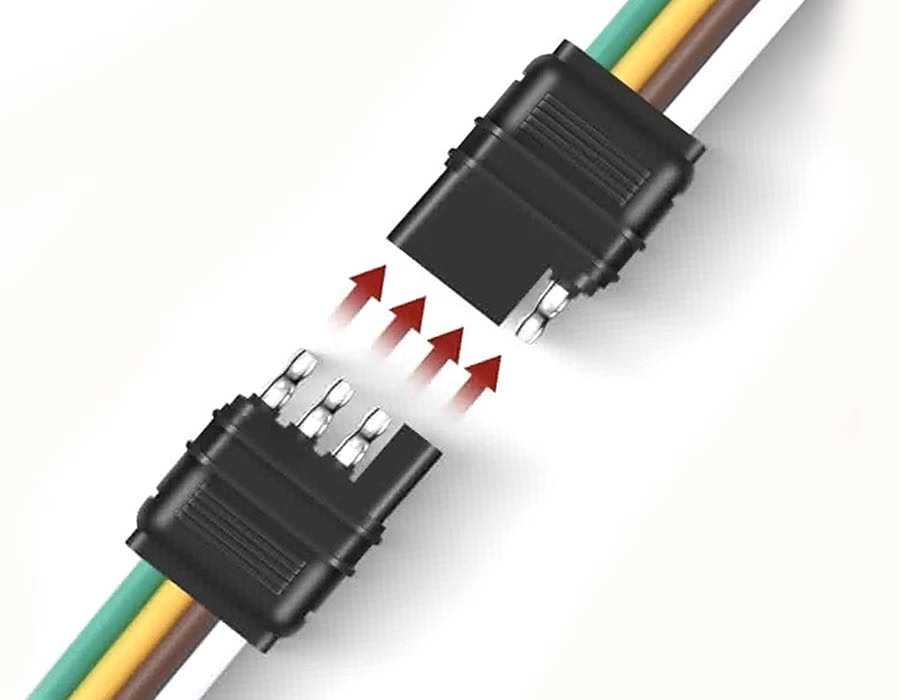
The 4-way flat connector is the simplest standard, found on most small utility, boat, and ATV trailers. It carries power for the two turn signals, brake lights, taillights, and ground. The typical color code is as follows: White = Ground, Brown = Tail/Running Lights, Yellow = Left Turn/Brake, Green = Right Turn/Brake.
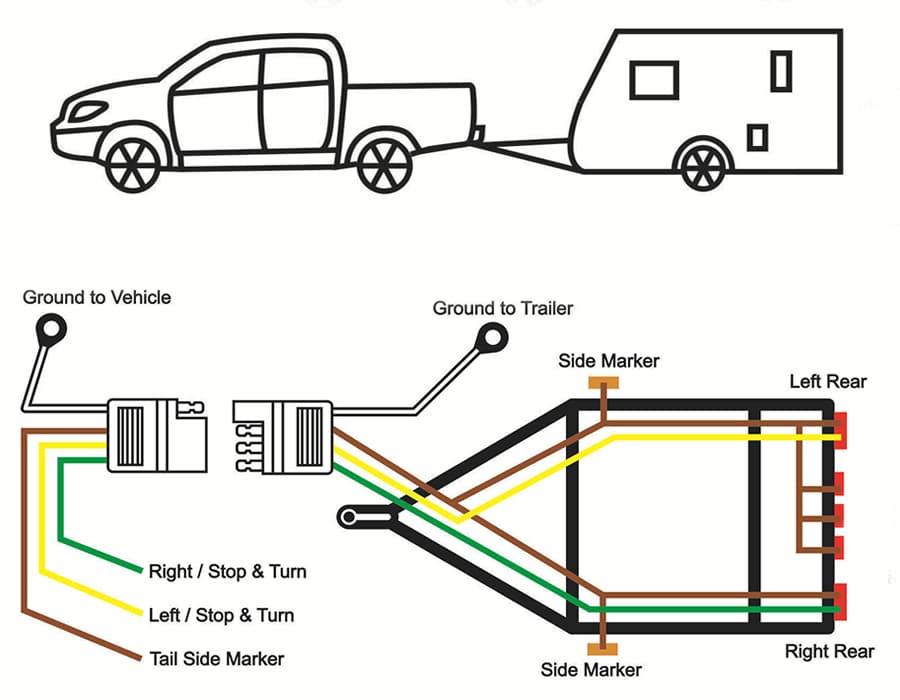
In practice, the white wire is grounded to the trailer frame, the brown wire powers the rear/marker lights, and the yellow/green wires power the left/right brake-turn signals, respectively. Keeping these four wires color-consistent simplifies repair and troubleshooting.
5-Way (Flat/Round) Connectors
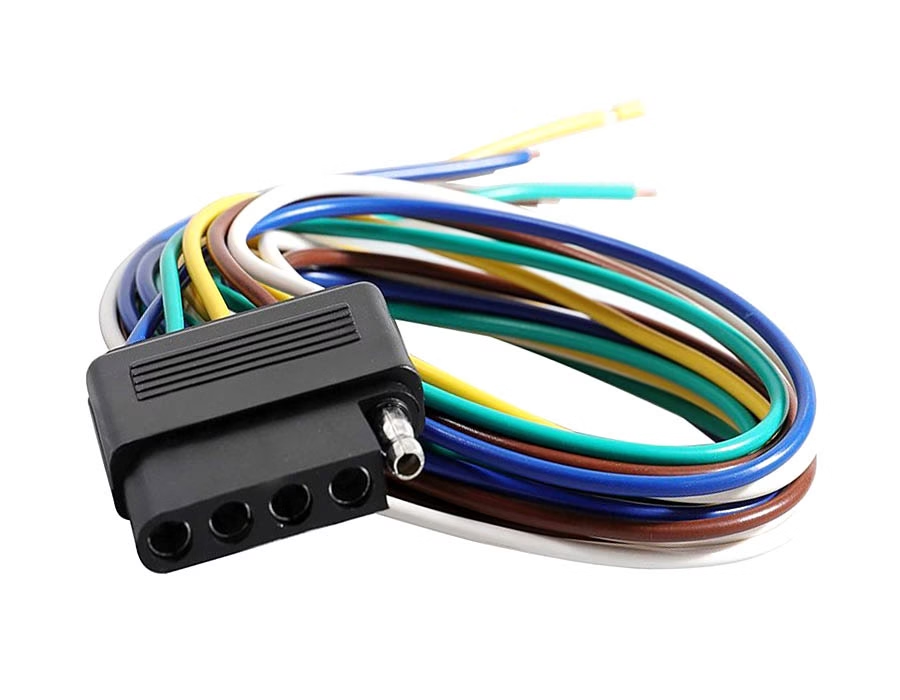
A 5-way connector adds one extra circuit to the 4-way setup (commonly used for either reverse lights or brake-controller lockout). The first four wires remain the same (white ground, brown tail, yellow left, green right). The fifth wire is usually blue (often the electric brake output on 5-pin harnesses) and is sometimes used for backup lights in “surge” brake systems.
In other words, a typical 5-wire harness is as follows: White = Ground, Brown = Tail, Yellow = Left, Green = Right, and Blue = Brake Controller Output (or Backup). (Because manufacturers vary, always use a circuit tester to confirm non-standard wiring.)
6-Way Round Connectors
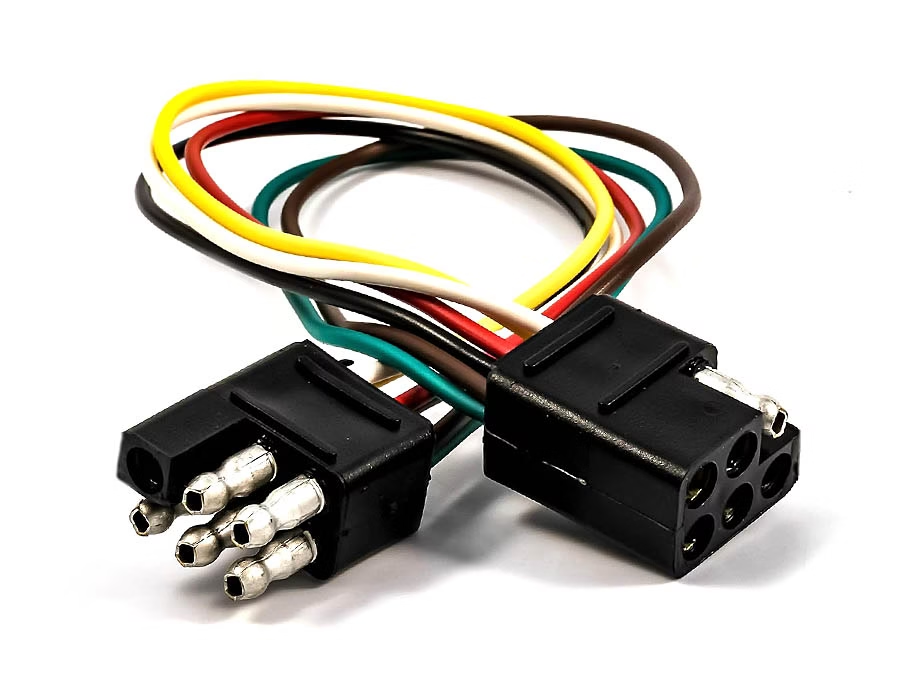
The 6-way round connector supports one more function than a 5-way: it typically adds an auxiliary 12V “hot” lead for charging or accessories. Its standard wiring is White = Ground, Brown = Tail lights, Yellow = Left turn/brake, Green = Right turn/brake, Blue = Electric brakes, Red = 12V auxiliary power. (Some layouts may swap wire colors for aux vs. brake, so verify for your trailer.) Six-wire plugs are often used on larger trailers (such as campers or horse trailers) that require a powered outlet, a battery charger, and an electric brake signal.
7-Way RV Blade Connectors
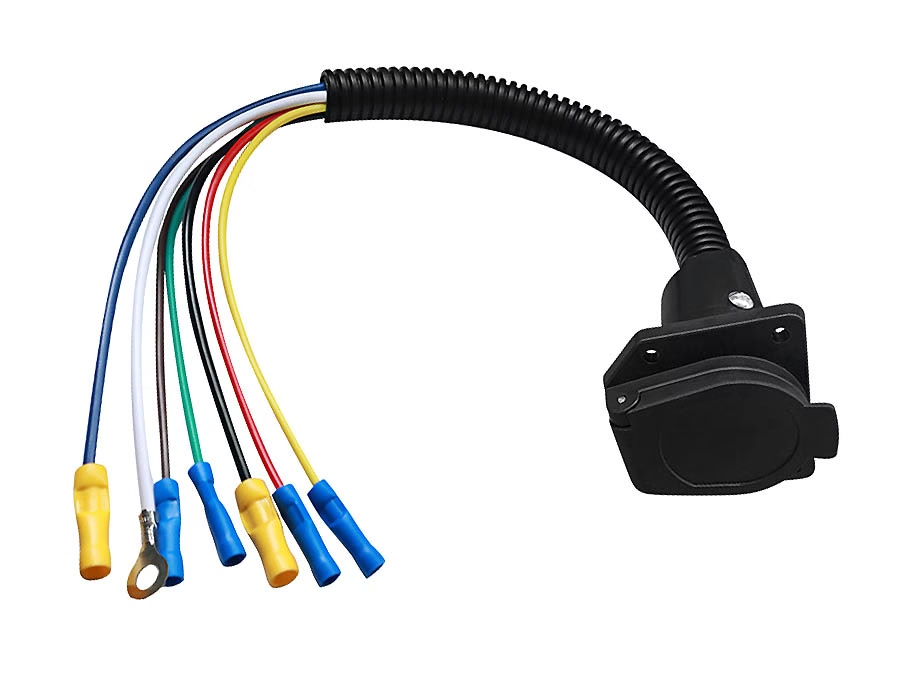
For heavy-duty trailers and RVs, the 7-way blade connector covers all functions: ground, running lights, turn signals, electric brakes, 12V power, and reverse lights. Most 7-pin blade harnesses use the following colors: White = Ground, Brown = Tail lights, Yellow = Left turn/brake, Green = Right turn/brake, Blue = Electric brakes, plus one wire for 12V auxiliary power and one for backup lights. (The aux and backup colors vary: in the SAE J2863 “RV” standard, orange = 12V and gray = reverse, while another standard scheme uses black = 12V and purple = reverse.)
For example, one pinout is: pin1 white (ground), pin2 black (aux 12V), pin3 yellow (left), pin4 purple (backup), pin5 Green (right), pin6 brown (tail), pin7 Blue (brakes). (Be sure to consult your vehicle and trailer manuals, as older “round” 7-pin connectors sometimes use a different color scheme.)
Looking for rugged, plug-and-play trailer wiring harnesses?
Romtronic designs and manufactures durable, custom trailer wire assemblies—built to spec for 4-way to 7-way, tested for harsh environments, and ready for OEM integration.
👉 Contact our engineering team for tailored solutions →
Color Code Reference Table
The table below summarizes typical wire colors and their functions for standard North American trailer connectors:
| Color | Function | 4-Pin Flat | 5-Pin Flat | 6-Pin Round | 7-Pin Blade (RV) |
|---|---|---|---|---|---|
| White | Ground (chassis –) | Ground | Ground | Ground | Ground (pin 1) |
| Brown | Tail / Running lights | Tail lights | Tail lights | Tail lights | Tail lights (pin 6) |
| Yellow | Left turn signal/brake light | Left turn/brake | Left turn/brake | Left turn/brake | Left turn/brake (pin 3) |
| Green | Right turn signal/brake light | Right turn/brake | Right turn/brake | Right turn/brake | Right turn/brake (pin 5) |
| Blue | Electric brake output | – | Brake output (or reverse) | Electric brakes | Electric brakes (pin 7) |
| Red (or Black) | Aux 12V power / Battery hot | – | Aux 12V (rare) | 12V auxiliary power | Battery 12V aux (pin 2; often black or red) |
| Purple (or Gray) | Reverse / backup lights | – | – | – | Backup lights (pin 4; often purple/gray) |
Table: Standard trailer wiring colors and functions.
Installation Best Practices
- Secure and Protect Wiring. Keep the harness supported (e.g., along the trailer frame) so road debris doesn’t chafe it. Use slack loops to avoid tension during turns, and check that wires aren’t pinched by moving parts.
- Ground Carefully. Ensure the white ground wire is cleanly attached to bare metal on the vehicle and the trailer. Bad or corroded grounds are a prevalent cause of lightning failures.
- Use Proper Gauge Wire. Heavy circuits (brake power, battery charge) should use thicker wire (10–12 AWG), while signal lights can use 14–16 AWG wire. Using too-thin wire may cause voltage drops, dim lights, or weakened brakes.
- Protect Connectors. When not towing, cover trailer plugs with weather caps or stow them indoors to prevent corrosion. Many drivers keep a 4-way flat harness in the cab when not in use, which helps extend the connector’s service life.
Troubleshooting Tips
- Test Each Circuit. If the lights aren’t working, use a multimeter or test light to verify each wire at the plug. Remember that colors vary, so matching functions (not just wire color) is the safest approach. Trailer wiring harnesses use standardized color codes to ensure lights are connected correctly.
- Check Fuses and Breakers. Some trailers (especially RVs) have inline fuses or breakers for lights and brakes. Inspect and replace any blown fuses in the towing vehicle and trailer.
- Inspect Connections. Look for loose or corroded plugs/sockets. Clean the connector pins and sockets with electrical cleaner or a wire brush. Ensure the plugs fully seat in their receptacles (a loose connection can cause intermittent breaks).
- Verify Ground. A classic troubleshooting step is to re-ground all lights. Temporarily attach all tail-lamp grounds to the trailer frame to verify that the lighting is restored.
Common Installation Mistakes
- Weak Ground: Failing to fasten the white ground wire to bare metal can cause all trailer lights to malfunction. Always sand away paint/grease before grounding.
- Mis-Matched Connectors: Attempting to mate a 6-pin plug with a 5-pin socket (or a socket with a different wiring standard) can cause circuit miswiring. Use the correct adapter or rewire the harness for compatibility.
- Wrong Wire Gauge: Using 16 AWG or thinner wire for brake power or battery leads causes a voltage drop. Brakes and charging wires should be 10–12 AWG.
- Neglected Maintenance: Dirty or water-filled connectors kill circuits. Routinely check and clean plugs—disconnect and seal them after cleaning to prevent moisture from entering.
Romtronic: Your OEM Trailer Harness Partner
Whether you’re rewiring a boat trailer, outfitting an RV, or designing an industrial tow-behind, Romtronic delivers custom trailer wire harnesses built to spec. Romtronic designs and tests each harness to handle extreme environments as a premier cable and wire harness manufacturer. Our engineers can craft anything from a simple 4-way flat harness to a complex 7-way RV cable with heavy-duty grommets and custom-length leads.
By leveraging ISO-certified production and rigorous testing, Romtronic ensures every OEM trailer wiring harness meets or exceeds industry standards.
For reliable, ready-to-install trailer wiring solutions, Romtronic’s team is a one-stop source—from fast prototyping to volume production. In summary, following the standard trailer wiring color code and best practices will ensure that your trailer lights and brakes operate safely.
For professional-grade harness assemblies, consider partnering with Romtronic to obtain a durable, custom-fit solution that integrates seamlessly.
.avif)
Sam Wu is the Marketing Manager at Romtronic, holding a degree in Mechatronics. With 12 years of experience in sales within the electronic wiring harness industry, he manages marketing efforts across Europe. An expert in cable assembly, wiring harnesses, and advanced connectivity solutions, Sam simplifies complex technologies, offering clear, actionable advice to help you confidently navigate your electrical projects.