Premier Manufacturer

In-vehicle networks are transitioning to Ethernet to support data-intensive systems. 100BASE-T1 (IEEE 802.3bw) provides 100 Mbps over a single twisted pair, while 1000BASE-T1 (IEEE 802.3bp) runs 1 Gbps on one pair. Both are full-duplex on a single cable, which reduces harness weight and meets stringent automotive EMC limits. For example, cameras or infotainment systems that are once on CAN or MOST can use 100BASE-T1, but advanced ADAS cameras often require 1000BASE-T1 speeds.
Performance Comparison
- Data rate/bandwidth: 100BASE-T1 maxes out at 100 Mbps, while 1000BASE-T1 offers 1 Gbps (10 times higher) bandwidth. Achieving 1 Gbps over one pair requires a 333.33 MHz clock with PAM3 signaling. In contrast, 100BASE-T1 uses lower-frequency PAM3 encoding (4B3B/3B2T) to limit emissions.
- Encoding: Both use multi-level Pulse Amplitude Modulation (PAM3) for efficiency. 100BASE-T1 uses a 4B3B/3B2T scheme with PAM3. 1000BASE-T1 also uses PAM3, but at a higher symbol rate (333 MHz) and with echo cancellation, allowing both ends to transmit simultaneously. This makes 1000BASE-T1 more sensitive to cable quality, while 100BASE-T1 is more tolerant.
- Reach: Both standards support approximately 15 m on automotive-grade cable. In practice, 100BASE-T1 links are engineered for lengths of≥15 m. 1000BASE-T1 links are Type A up to 15 m, with an optional Type B spec up to 40 m. (In the lab, unshielded 1000BASE-T1 often runs ~20 m.) Shorter runs in cars usually handle either rate, but long backbone spans may prefer gigabit with top-quality cable.
Installation & Wiring
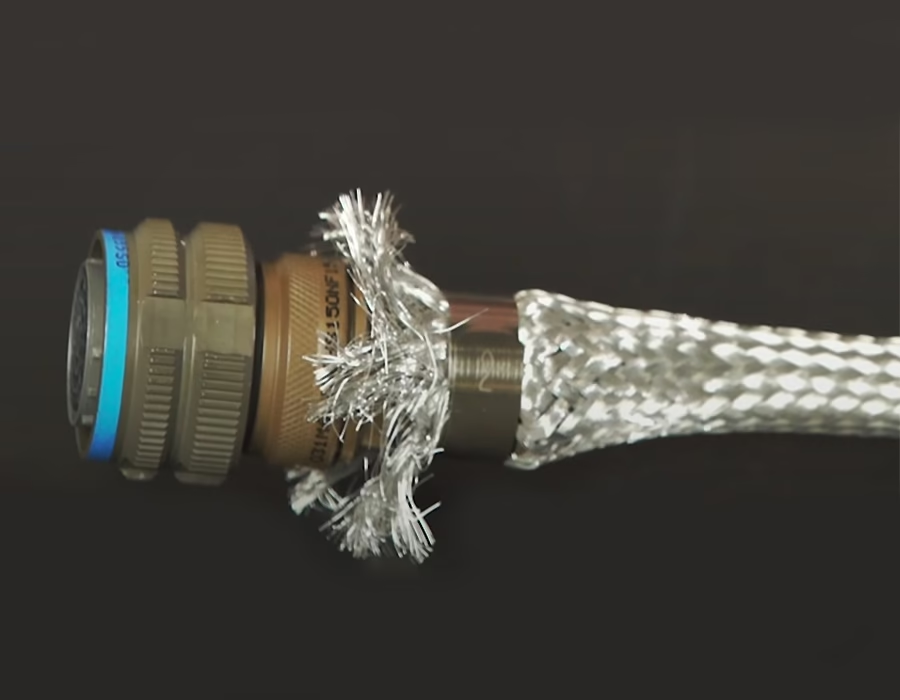
Automotive Ethernet uses single twisted-pair wiring. 100BASE-T1 typically runs over unshielded twisted pair (UTP) to save cost and weight. 1000BASE-T1 often requires shielded cable to meet EMI specs. In fact, at present, 1000BASE-T1 over unshielded lines can fail CISPR-25 tests, so auto makers use shielded twisted-pair (STP) for gigabit links.
Standard automotive connectors (e.g., TE’s HSD series) support both rates. Harness design must account for these: shielded cable and connectors add cost and size, but enable reliable, higher data rates. Both standards tolerate similar environmental stresses, though 1000BASE-T1 may have stricter requirements on impedance and insertion loss due to the higher frequency.
Compatibility & Use Cases
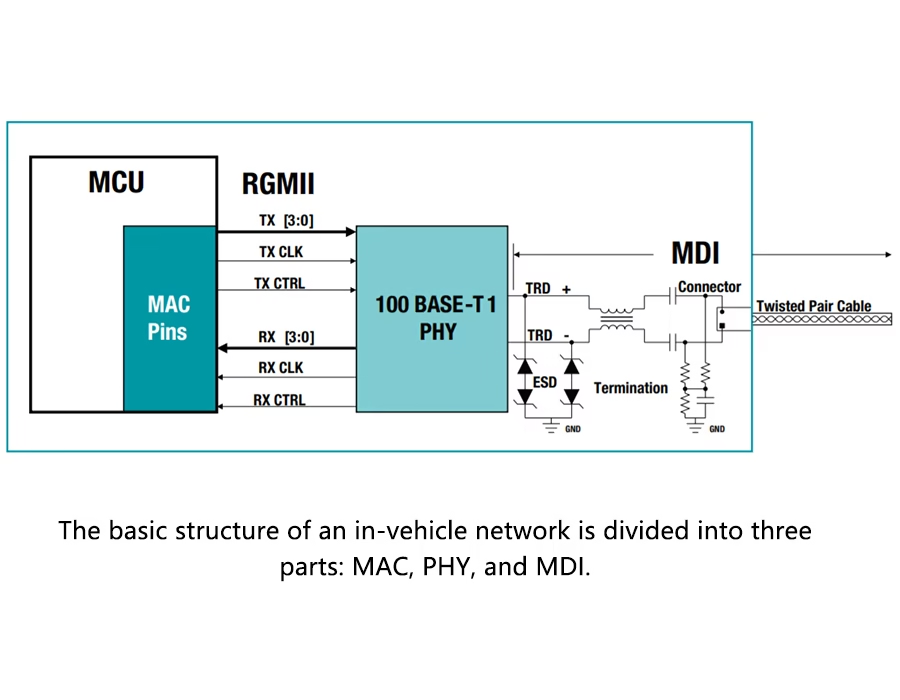
Both speeds utilize standard Ethernet frames and MAC layers, allowing them to coexist in a network. Some PHYs and switches support auto-negotiation between 100BASE-T1 and 1000BASE-T1 on the same port. In practice, networks are often zonal: lower-speed 100BASE-T1 links connect sensors, microphones, or speakers, while gigabit trunks tie together cameras, LIDAR, and central compute.
For example, a backup camera or audio-video bus may run at 100 Mbps, but a 4K camera stream for ADAS requires 1 Gbps. Automotive infotainment domains sit in between. In short, 100BASE-T1 works for standard infotainment and CAN-replacement tasks, whereas 1000BASE-T1 is chosen for high-bandwidth needs (zonal backbones, multiple HD cameras, advanced driver assistance).
Cost Considerations
100BASE-T1 components (PHY chips and connectors) tend to be simpler and less expensive, and cables can be unshielded. 1000BASE-T1 gear is more complex: PHYs work at higher frequencies and often need better filtering, and cables/connectors may be shielded. However, 1000BASE-T1 can reduce cabling: one gigabit link can replace multiple 100 Mbps links. 1000BASE-T1 can yield up to a 4× reduction in cable runs compared to four 100 Mbps lines, with a similar overall BOM cost.
In practice, OEMs weigh the higher component cost of gigabit transceivers against the savings in harness weight and complexity. Over time, economies of scale have brought 1 Gbps PHY costs closer to those of 100 Mbps parts. However, today, 100BASE-T1 installations generally cost less upfront.
| Attribute | 100BASE-T1 (802.3bw) | 1000BASE-T1 (802.3bp) |
|---|---|---|
| Data Rate | 100 Mbps | 1000 Mbps (1 Gbps) |
| Reach | ≈15 m on automotive cable | ≈15 m (Type A) on automotive cable; optional up to 40 m (Type B) |
| Cabling | Single twisted pair (often unshielded) | Single twisted pair (often shielded for EMI) |
| Signaling | PAM3 with 4B3B/3B2T encoding | PAM3 at 333 MHz (with echo-cancellation) |
| EMC | Optimized for CISPR-25 Class 5 (low emissions) | Higher emissions risk; usually uses shielded cable |
| Typical Uses | Infotainment audio/video, diagnostics, sensors, backup camera | HD camera networks, zonal backbone, high-speed infotainment, ADAS data |
Conclusion
In summary, 100BASE-T1 and 1000BASE-T1 each have roles in a modern car network. 100BASE-T1 is well-suited for lighter-duty links (such as audio, simple video, and CAN replacement), with simpler cable and PHY requirements. 1000BASE-T1 delivers gigabit throughput for camera-rich ADAS zones and high-speed domains, at the expense of more demanding cabling and transceivers. OEMs should match the cable choice to the required bandwidth and reach, while also considering weight and cost trade-offs.
Romtronic offers automotive-grade Ethernet cable assemblies built to support both 100BASE-T1 and 1000BASE-T1 systems. As a trusted cable manufacturer, Romtronic helps OEMs and Tier 1s implement reliable, application-matched Ethernet solutions tailored to today’s evolving automotive environments.
.avif)
Sam Wu is the Marketing Manager at Romtronic, holding a degree in Mechatronics. With 12 years of experience in sales within the electronic wiring harness industry, he manages marketing efforts across Europe. An expert in cable assembly, wiring harnesses, and advanced connectivity solutions, Sam simplifies complex technologies, offering clear, actionable advice to help you confidently navigate your electrical projects.