


Condensation, Compressor Vibration, and Voltage Noise — All in One Enclosure
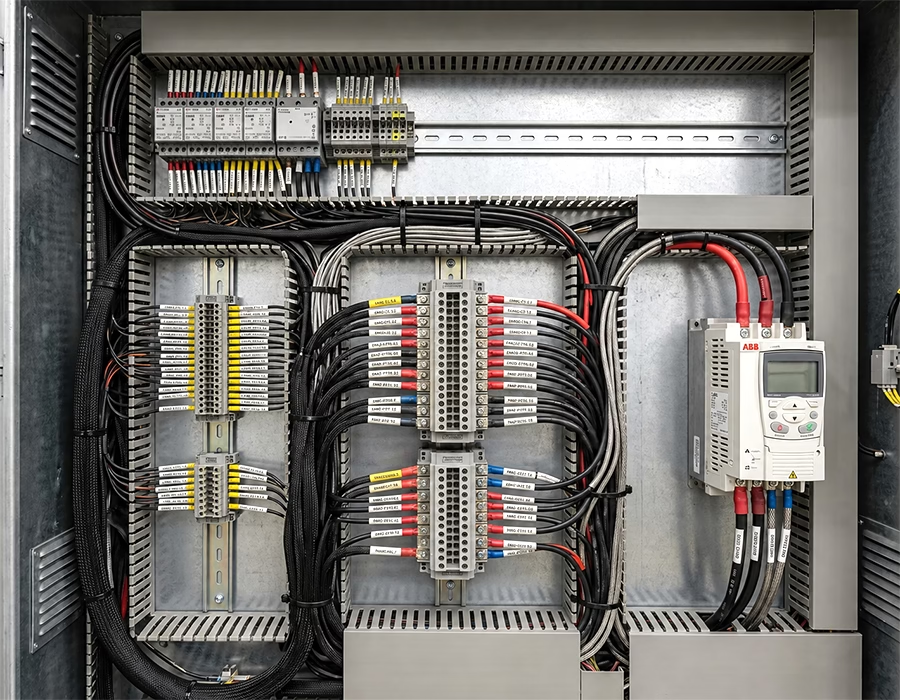
Wiring an HVAC climate control system means solving a specific set of engineering problems, and a commercial chiller or rooftop unit is where they all show up at once. You’ve got low-voltage digital thermostats, Modbus communication lines, and delicate temperature thermistors running right next to high-amperage compressor starters, heavy fan contactors, and variable frequency drives (VFDs), all packed into the same cabinet.
That’s a rough neighborhood for a wire to live in. Internal harnesses inside these outdoor enclosures deal with constant low-frequency vibration from heavy scroll compressors. On top of that, they’re fighting humidity, driving rain, condensation cycles, and voltage spikes every time the grid cycles.
What a Single Failed Harness Actually Costs You
Here’s what that means in practice: one control jumper fails because moisture got in, or a terminal backs itself loose from vibration, and your whole refrigeration loop drops out. Or worse, it doesn’t fail cleanly. It just starts feeding erratic sensor data and short-cycling the compressor. Either way, you’re looking at spoiled cold storage, frozen commercial pipes, and an emergency service call nobody budgeted for.
We build our HVAC climate control wire harnesses specifically so that doesn’t happen. That means high-performance internal harnesses, overmolded waterproof sensor trunks, and anti-vibration terminal blocks engineered to handle thermal expansion, while still keeping communication logic isolated from contactor arcing.
We Take the Guesswork Out of Small-Batch HVAC Production
We’ve spent 29 years in OEM and ODM contract manufacturing for industrial climate control and refrigeration equipment. If your team runs high-mix, low-volume (HMLV) building automation projects, that’s exactly the kind of work we’re built for. So, we take panel layout headaches off your plate.
Send us your cabinet layouts and schematics, and we’ll ship back pre-tested, fully verified drop-in harnesses ready for your assembly floor. That way, you won’t need to manage internal wiring sub-processes.
- ISO 9001 factory validation. Every HVAC harness runs through our certified quality pipeline before it ever gets packed.
- IPC-A-620 Class 3 build standard. Every internal wiring branch, heavy-duty termination, and shield ground meets the highest workmanship standard used in high-reliability industrial electronics.
- Three-gate inspection. We check every assembly through an automated post-crimp optical sweep, a high-voltage insulation dielectric test, and a final mechanical pull test.
- Moisture, oil, and flame-resistant jacketing. We use cross-linked polyethylene (XLPE) and polyurethane (PUR) insulation built to shrug off condensation, compressor oils, and thermal strain without cracking. (Not sure which jacket material fits your application best? Worth a quick read.)
What Actually Goes Wrong in HVAC Climate Control Wiring — And How We Design Around It
Sloppy point-to-point field wiring is a slow-motion failure waiting to happen. Moisture pools in unsealed conduits, heat gets trapped inside compact drive cabinets, and troubleshooting turns into a guessing game.
That’s why we pre-sort and pre-bundle our wire harness kits before they ever leave the factory. They drop straight into control enclosures, compressor bays, and outdoor fan modules without extra field labor:
- Gas-tight crimps. Constant compressor vibration works standard screw terminals loose over time. We monitor crimp force automatically on every locking ring and spade terminal, so you get a gas-tight cold weld that doesn’t shift under vibration.
- Low-capacitance, double-shielded Modbus lines. To keep Building Automation System (BAS) loops from dropping packets near fan contactors, we wrap data pairs in a high-coverage (95%+) tinned copper braid, backed by an aluminum foil layer.
- Laser-marked, pre-bundled branch layouts. Every conductor gets laser-marked with alphanumeric tags every 20mm. We pre-bind them so each one routes straight to the right controller terminal or I/O block—no guesswork on the line.
Material and Compliance Reference for HVAC Climate Control Wiring
| Wiring Application | Material Spec | Why It Matters |
|---|---|---|
| Compressor & fan power feeds | UL 3173 / UL 3271 XLPE conductor | Rated 600V up to 125°C. Resists embrittlement from heat and refrigerant exposure |
| Sensor & thermistor extensions | Overmolded IP67/IP68 connectors, PUR jacket | Blocks moisture, frost condensation, and driving rain from shorting low-voltage sensors |
| VFD & inverter control links | Twisted, double-shielded tinned copper with drain wire | Grounds high-frequency switching noise from variable-speed compressor drives |
| Internal panel logic loops | UL 1015 tinned copper, flame-retardant PVC | Rated 600V up to 105°C. Flexible routing and flame resistance in tight starter boxes |
Two Failure Modes We Design Every HVAC Harness Around
EMI Cross-Talk from High-Power Fan Contactors
When a heavy-duty fan contactor snaps shut, it throws off a big inductive voltage transient. Run your low-voltage sensor lines, RS-485 runs, or safety float switch feedback too close to those power feeds, and that noise shows up as false sensor errors, communication timeouts, or relay drops you can’t explain.
We design around this with custom-shielded branch harnesses. Sensitive communication lines sit inside a tinned copper-braid Faraday cage (95%+ coverage) with dedicated drain wires, which ground out high-frequency noise and keep your data streams clean through every contactor cycle.
Terminal Fretting Corrosion from Compressor Vibration
Rooftop units shake constantly from heavy scroll and screw compressors. Over months, that micro-vibration lets copper strands shift and rub inside loosely-crimped terminals. That friction oxidizes the contact points, resistance climbs, and eventually you’ve got an overheating wire nobody saw coming. (We’ve written more on how connector plating resists corrosion and mating-cycle wear if you want the deeper mechanics.)
We build to strict IPC-A-620 Class 3 standards to prevent this: high-strand-count conductors, precision-molded locking terminals, and gas-tight compression seals. That combination kills internal micro-movement and the oxygen pockets that cause fretting in the first place — the kind of detail that’s also central to preventing vibration-related harness failures more broadly.
Frequently Asked Questions
What wire is best for HVAC control panels?
For internal panel logic loops, UL 1015 tinned copper with flame-retardant PVC insulation is the standard choice — rated for 600V up to 105°C, with enough flexibility for tight starter box routing. For anything running near a compressor or VFD, you’ll want XLPE or PUR jacketing instead, since PVC alone doesn’t hold up as well against oil and thermal cycling.
How do you prevent condensation from damaging HVAC wiring?
The main defense is overmolded, IP67/IP68-rated waterproof connectors on any sensor or thermistor extension exposed to the enclosure’s interior. Combined with PUR jacketing and properly sealed conduit entries, this keeps ambient moisture and frost condensation from ever reaching an exposed contact point.
What is IPC-A-620 Class 3, and why does it matter for HVAC harnesses?
IPC-A-620 Class 3 is the highest industry standard for cable and wire harness assemblies, typically reserved for high-reliability electronics. For HVAC climate control systems specifically, it governs termination quality, strand count, and shield grounding. Those details directly affect whether a harness survives years of vibration and thermal cycling without a fretting failure.
Why does my HVAC control wiring keep tripping out or reading erratic sensor data?
This is almost always either moisture ingress at a poorly sealed connector, or EMI noise bleeding into a signal line running too close to a fan contactor or VFD. Fortunately, both have known fixes: waterproof overmolded connectors for the first, and properly shielded, drain-wire-equipped cable for the second.
What causes wire terminals to fail in HVAC compressor applications?
Constant low-frequency vibration from scroll and screw compressors slowly loosens standard screw terminals, and micro-movement inside a poorly crimped terminal causes fretting corrosion over time. Gas-tight crimping and precision-molded locking terminals are the standard fix.
Do I need shielded cable for VFD and Modbus lines in an HVAC system?
Yes, in almost every case. VFDs generate significant high-frequency switching noise, and unshielded communication lines running nearby will drop packets or throw false errors. Double-shielded cable with a dedicated drain wire is the standard solution for both VFD control links and Modbus/RS-485 runs.
Put Our HVAC Climate Control Interconnect Lab to Work
High-capacity climate control leaves zero room for erratic signals, brittle insulation, or loose terminations. Maybe you’re chasing down intermittent sensor drops. Maybe you’re re-engineering a VFD cabinet layout, or scaling up a new commercial chiller line. Either way, we can help you get ahead of it.
Want to see real-world teardown data from HVAC harnesses we’ve built for other brands? Just ask. Our engineering team is happy to share it.
Send your 2D wiring prints, cabinet schematics, or BOM to our Engineering Hub. Our team of 12 wiring engineers will run a full DFM audit and send you a clean production quote within 24 hours.
If your build also touches control cabinets or servo-driven equipment, our pages on PLC control cabinet wiring and servo motor drive harnesses cover the adjacent engineering in more depth. And if you’re building out the reliability case for a long-running deployment, our guide to extending cable assembly lifespan in harsh environments is a solid next read.