Premier Manufacturer

Designing waterproof cable assemblies carries significant risks. From underwater drones and outdoor sensors to industrial washdown equipment and automotive systems, a single point of leakage can trigger short circuits, degradation/corrosion, or complete system failure. The following practical guidelines ensure connection points remain both reliable and fully moisture-proof.
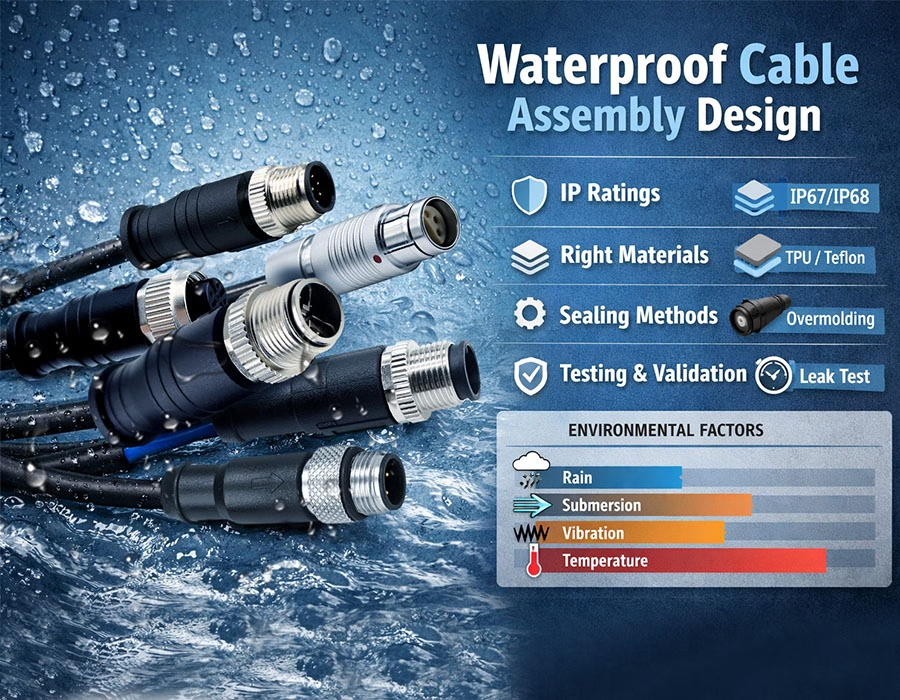
1. Understand the Environment
Before selecting materials or connectors, define your operating conditions:
- Exposure: rain, splashing, immersion, chemicals, or saltwater
- Movement: bending, vibration, or twisting
- Temperature: -40°C to 80°C for harsh environments
- UV, mildew, or corrosion risks
Tip: Early consideration of environmental factors determines IP rating, materials, and sealing strategy.
2. Define Your IP Rating
The Ingress Protection (IP) rating system sets standards for water resistance:
| Rating | Protection | Typical Use Case |
|---|---|---|
| IP65 | Water jets (nozzles) | Outdoor rain, light washing |
| IP67 | Temporary immersion (1m/30min) | Accidental drops, heavy storms |
| IP68 | Continuous immersion | Pools, deep-sea sensors |
| IP69K | High-pressure, high-temp wash-down | Food processing, industrial equipment |
Note: Real-world conditions include movement, vibration, and temperature cycling. Choose an IP rating that matches actual use.
3. Material Selection
The cable assembly is only as strong as its weakest material.
Cable Jacket Options:
- TPU: Excellent water resistance, flexibility, and abrasion protection
- Teflon (FEP/PTFE): Superior chemical and temperature resistance
- PVC: Adequate for light moisture, but may degrade if submerged long-term
Sealing Materials:
- O-rings, LIM (Liquid Injection Molding), adhesive dispensing, or overmolding
- Water-blocked tapes or gel fillers prevent capillary “wicking.”
4. Connector Design
Most waterproof failures occur at the connector. Tips:
- Use connectors with internal O-rings or seals
- Circular connectors (M8/M12) offer uniform sealing via threaded locking
- Push-Pull connectors: ensure a secure “click.”
- Match the connector and cable OD for proper compression
5. Sealing Techniques
Effective sealing is structural, not cosmetic. Common methods:
- Overmolding: Creates a single bonded piece at the cable-connector junction
- Adhesive-lined heat shrink: Useful for prototypes or small repairs
- Potting (Epoxy/Silicone): Permanent moisture block
6. Strain Relief and Mechanical Design
Waterproof cables often fail mechanically before electrically. Proper strain relief:
- Spreads the bending forces over a longer distance
- Secures the cable inside the overmold
- Prevents twisting or pulling at critical points
7. Avoiding the Wicking Trap
Water can travel inside the cable through gaps between strands. Prevent this by:
- Using water-blocked cables with swellable tape or fillers
- Ensuring potting compounds penetrate all conductor spaces
8. Testing and Validation
Don’t trust datasheets alone—test assemblies under real-world stress:
- Vacuum/Leak Testing
- Dielectric Withstanding Voltage (DWV)
- Thermal Cycling
9. Common Waterproof Design Mistakes
- Only sealing the connector
- Mismatched cable and connector dimensions
- Ignoring strain relief
- Skipping flex, aging, or immersion tests
- Overdesigning or under-specifying materials
10. Maintenance and Repair Considerations
Even the best waterproof cable may need field maintenance:
- Use durable, easy-to-apply sealing materials
- Semi-cured or flexible compounds maintain long-term sealing
- Provide clear instructions for repairs
11. Romtronic Support for Waterproof Projects
At Romtronic, we help engineers design and manufacture custom waterproof cable assemblies:
- Material selection guidance
- Connector and overmolding design review
- Prototype validation
- Environmental and reliability testing
CTA: “Need a waterproof cable assembly for your project? Contact our engineers today to review your design and ensure it meets your IP requirements.”
FAQs
A: IP67 withstands temporary immersion up to 1m for 30 minutes. IP68 is rated for continuous immersion at the specified depth and for the specified time.
A: Overmolding is ideal for connectors and junctions, but the cable must also have compatible jacket materials.
A: Use water-blocked cables with swellable tape or ensure potting compounds penetrate between conductors.
A: Test assemblies during prototyping, after manufacturing, and periodically in harsh service environments.
.avif)
Sam Wu is the Marketing Manager at Romtronic, holding a degree in Mechatronics. With 12 years of experience in sales within the electronic wiring harness industry, he manages marketing efforts across Europe. An expert in cable assembly, wiring harnesses, and advanced connectivity solutions, Sam simplifies complex technologies, offering clear, actionable advice to help you confidently navigate your electrical projects.